How To Photograph Leopards: Tips & Tricks
Leopards are one of my favourite animals I have ever photographed.
Not only are they absolutely incredible animals, but the fact that they are the most elusive of the Big 5 makes it all the more exciting when you finally spot one!
Unfortunately, not everyone gets the chance to see them during a safari (even if you stay for a week) because of how elusive they are, but if you get lucky, you’re going to want to be prepared.
That’s why I’ve put together this guide on how to photograph leopards with everything you need to know if you get the chance to capture one through your lens.
Where to see Leopards in the Wild
There are a few different species of leopards around the world such as the Amur Leopard in Russia, Snow Leopard in Central Asia and the Javan Leopard in Java.
But if you’re reading this post, you’re most likely going to see the common leopard in Africa.
You can see them in a number of countries but the most popular (and most convenient for safaris) are Zambia, Botswana, Tanzania, Kenya and South Africa, where I was lucky enough to see a leopard.
Tracking Leopards
There are two ways to say leopards while on a safari trip in Africa. That being said, tracking leopards is incredibly hard as they are one of the most difficult animals to find on a safari.
The first way is by self-driving in a National Park such as Kruger National Park, but honestly I would not recommend this. You can only stick to main roads and see what you see from your car, you can’t get out to take photos.
So the second way is the best way and that is by taking game drives like I did at the Moditlo Nature Reserve. I took 2 game drives a day for 6 days and had the most incredible experience.
It also massively increases your chances of seeing leopards (and anything else to be honest) because you have an expert driver and local tracker. It’s their job to find the animals for you to see. Naturally, they’re a lot better at tracking leopards than me or you
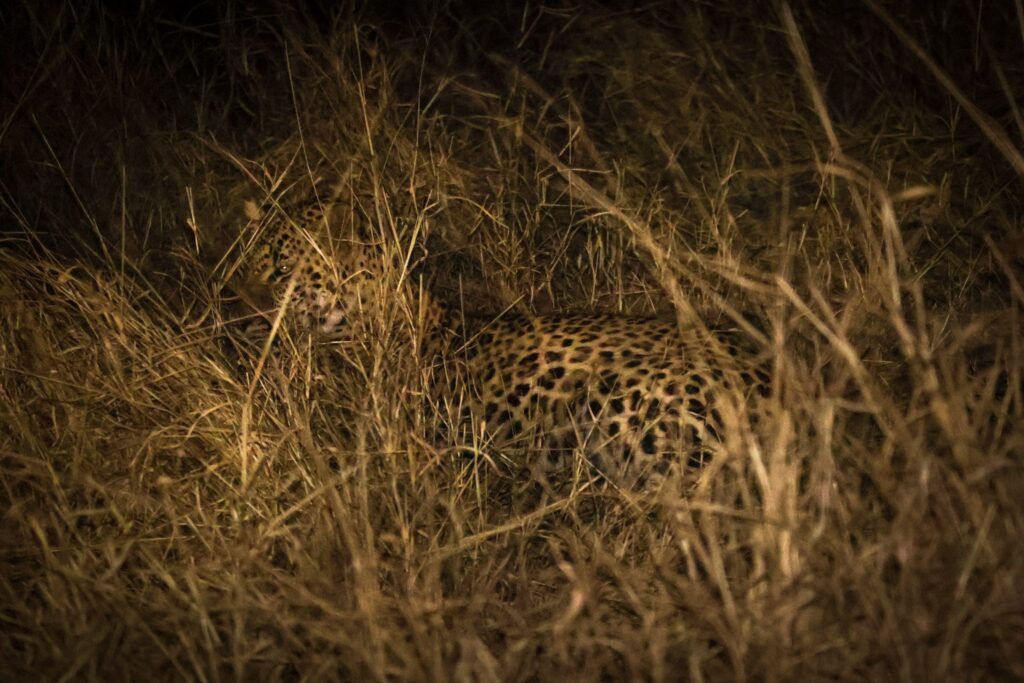
Leopards are most active at night, meaning you are more likely to see them towards the end of your evening game drive. They’re territorial animals so if you know the right area to look in, you could find one.
If you do choose the self-drive option, you want to look for prints which are similar to dog prints, but larger. They’ll be about 4 inches apart and the hind track will be slightly longer than the front track.
Leopards sleep in trees and usually eat their kills in trees too, so make sure you are always looking up into trees as well as scouting the ground. They’re solitary creatures, meaning they live alone (apart from when raising cubs).
The last clue you can use if you are self-driving is to look at the prey animals such as wart hogs or antelope. If they are grazing without a care in the world, there probably isn’t a leopard or any other predator animal in the area.
But all in all, remember that leopards are very elusive and shy animals, so they are pretty hard to find. I only saw one during my 12 game drives.
Leopard Behavior
One of the best general wildlife photography tips I have for beginners is to study the animals you are trying to photograph.
If you want to photograph a bird, for example, learn the signs that it’s going to start flying, or that it’s going to spread it’s wings, etc. etc.
For leopards, this is pretty much identical to house cats in terms of their mannerisms when stretching, yawning, grooming and all of those behaviours.
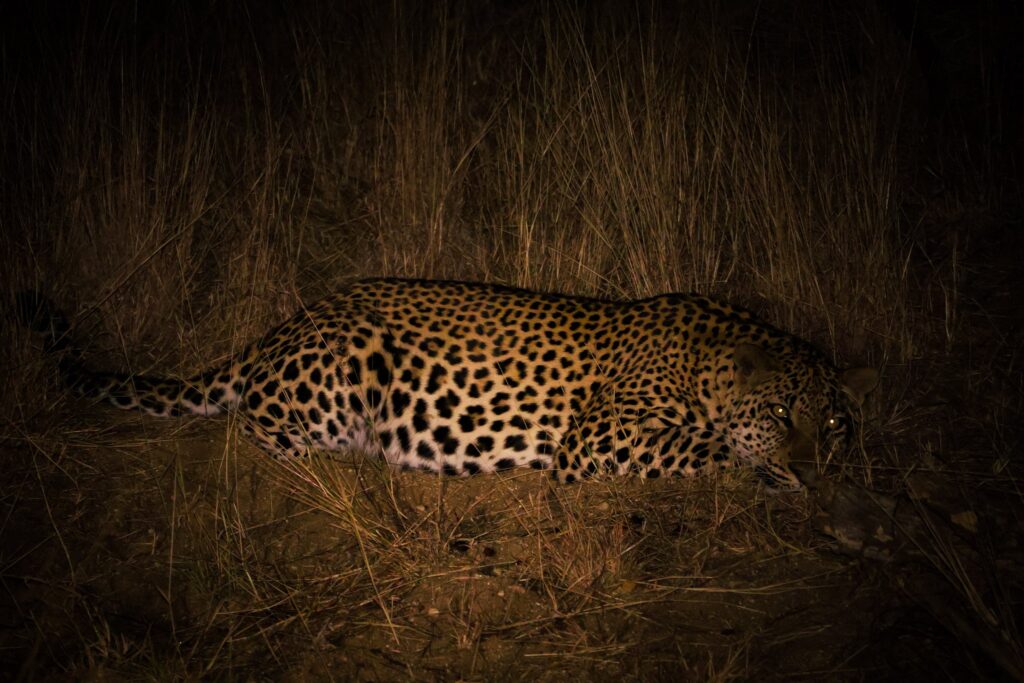
The main two unique behaviours for leopards you need to look out for compared to house cats are signs that they are going to begin sprinting, or signs that they are about to climb a tree. Because these are 2 shots which you do not want to miss, right?
Firstly, climbing a tree is pretty obvious. They’re going to be near a tree sniffing and looking up. They also sleep in trees so if you can find them while they are asleep, it can make for great photos. Unfortunately, I wasn’t able to see this.
For sprinting, look for signs that the leopard is hunting – is it sniffing the ground, stalking any prey animals, etc? This is when a leopard is most likely to sprint. They can reach speeds of up to 50-60km per hour, so make sure you shoot in burst mode to make sure you get some shots which are sharp without motion blur.
Leopard Photography Tips
For most photographers, seeing a leopard in the wild is a once-in-a-lifetime experience, so it’s important to make the most of your time with the leopard and get the best shot possible. Here are some tips for leopard photography:
Learn how to Photograph in Low Light Conditions
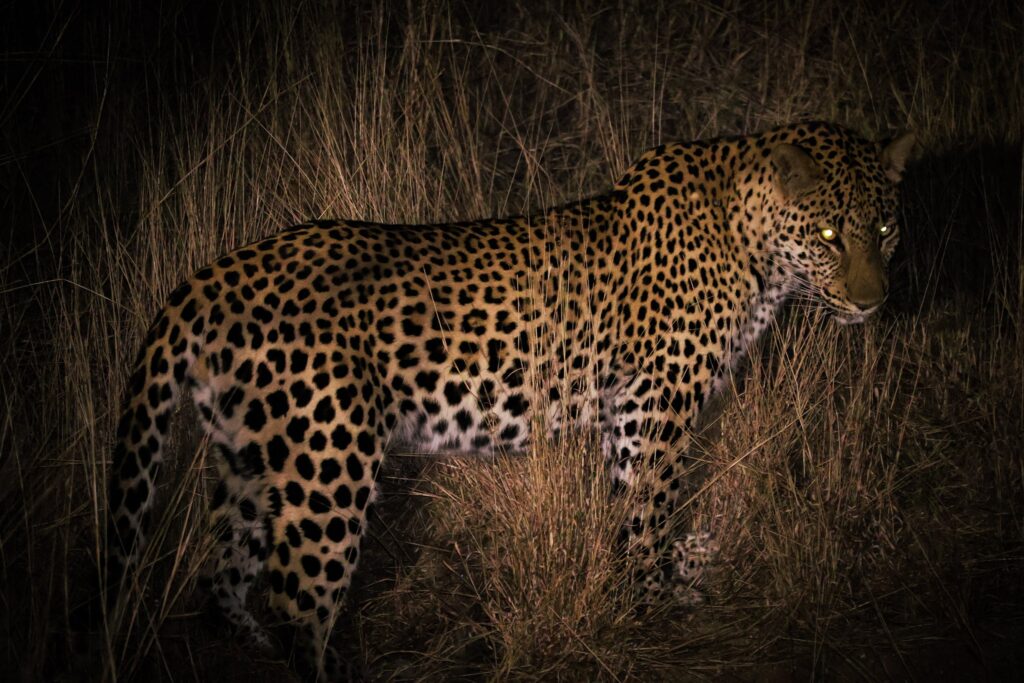
As leopards are most active at night, the chances are that you are going to come across one at night.
One of the best skills you can pick up as a wildlife photographer is how to shoot in low-light conditions.
In short, what you need to do is increase your ISO while maintaining a high shutter speed.
Top Tip: Lots of photographers are hesitant to shoot with high ISOs as it makes the image have more noise. Shoot in RAW format so you have more freedom in editing post-shoot.
Be Patient
It’s one of the most important rules of wildlife photography but it particularly applies to leopards.
If there has been a leopard sighting in the area and no one has seen it leave, it’s most likely still there but just waiting for everyone to leave (remember, they are shy animals).
If possible, outstay the other cars and jeeps and see if it reappears, because it usually does.
Focus on the Eyes
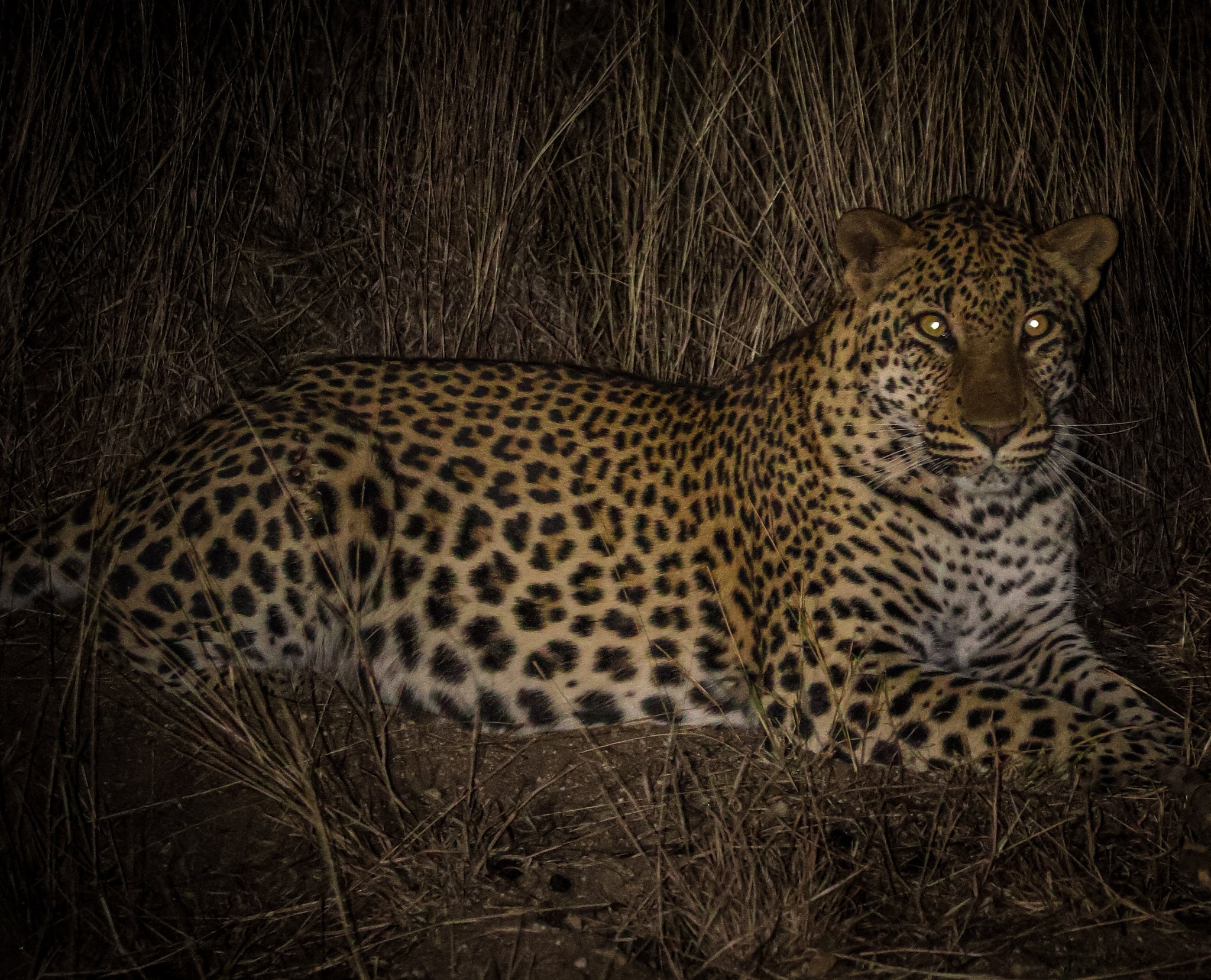
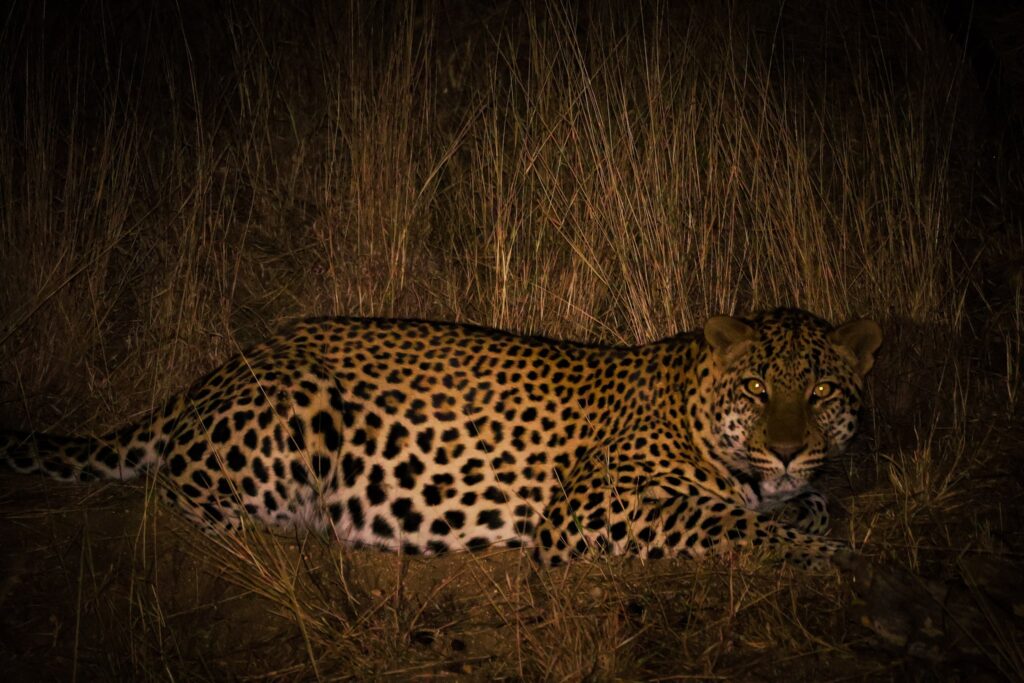
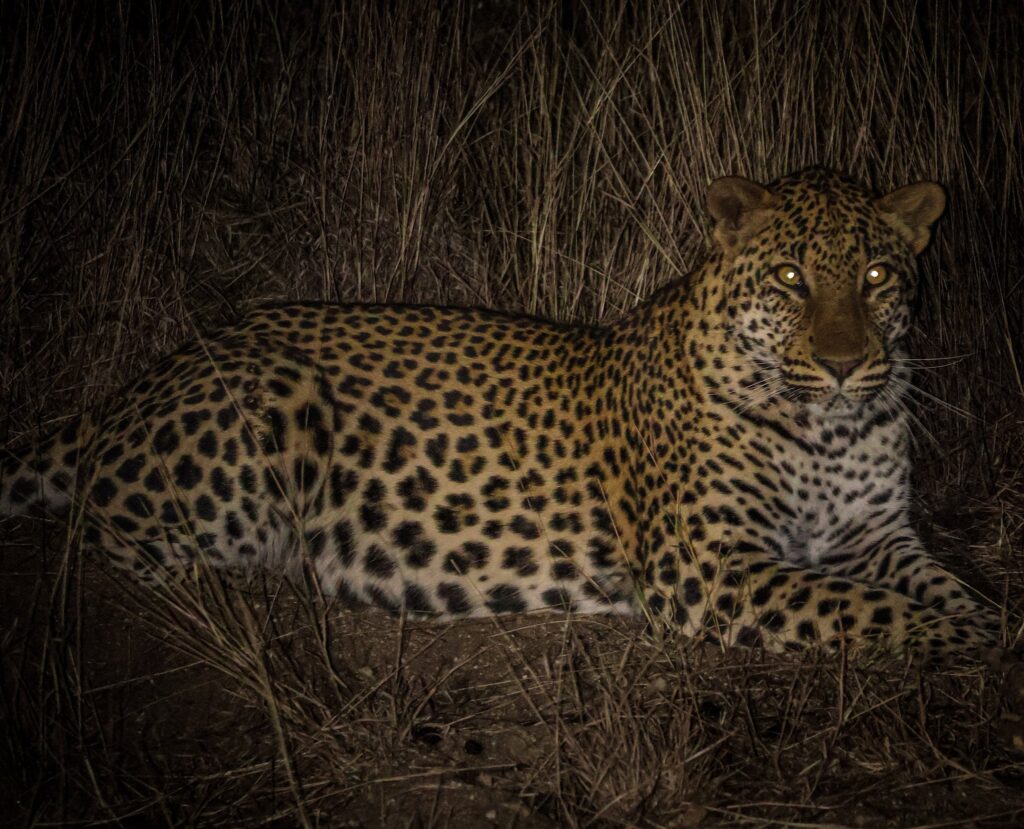
Leopards’ eyes are mesmerising and should be the focus of most of your shots. Getting a photo where the leopard was looking down my lens remains one of my favourite photos of all time, even though it might not be my “best”.
The eyes are so strong and powerful, and give a perfect focal point for your images.
Shoot in Burst Mode
Leopards can move pretty fast (when they’re not lying down that is!) so shoot in burst mode to reduce motion blur and ensure you have a few shots that are completely sharp and in focus.
Another top tip I have for beginner photographers is to take more photos rather than less. It’s better to have 300 photos with 10 good ones, than 30 photos with only 1 good one.
You can use Flash
One of the biggest debates in wildlife photography is whether you should use flash or not.
It’s personal preference but if you want to use flash with leopards, you can. Most big cats, leopards included, are completely unbothered by the flash.
Important: Never use a flash when photographing African Elephants.
Don’t zoom in for every shot
I know I just said to focus on the eyes as they’re so striking, but make sure you get other shots as well as simply portraits of the leopard.
Using a narrow aperture and zooming out a bit can help to tell more of a story as you can capture the surrounding environment, as well as the leopard itself. This is also a good tip if your lens’ focal length isn’t big enough to get portraits of the leopard.
Shoot eye-level if possible
It’s easier said than done while on safari, but if you can shoot eye-level, definitely do so. It makes the images so much better, even just being a metre lower than shooting from a safari jeep.
One way to do this is to lower your camera outside the jeep and use your camera’s display screen to look at the composition and choose your focal point.
Important: Some National Parks and Game Reserves forbid you to put your arms outside of the jeep. Obviously do not shoot eye-level if this is the case.
Another option is to take a walking safari – one of my bucket list experiences! These are particularly popular in Zambia.
Camera Equipment & Settings
- Camera: DSLR or mirrorless with high ISO performance.
- Lens: Telephoto lens (300-600+mm) with wide aperture (f/2.8-f/4).
- Shutter Speed: 1/500th to 1/1000th for movement; slower for resting shots.
- Aperture: Wide aperture (f/2.8 to f/4) for night shots.
- ISO: 3200-12800 for low-light sensitivity.
- Focus Mode: Continuous autofocus with multiple focus points for tracking movement.
Knowing how to get the right shot is one thing, but being set up to get the right shot is another thing. This is what I recommend for photographing leopards, with the assumption that you come across them in low-light conditions.
Firstly, you need a decent camera body that can handle high ISO so you don’t end up with images that have a ton of noise. Personally, I use mirrorless as they have a quite shutter speed and faster burst mode, which suits photographing wild animals better.
In terms of lens, it goes without saying that you need a telephoto lens to take really good photos of a leopard. But it is possible to use lenses with shorter focal lengths such as the Canon 55-210mm lens, but ideally, you want a telephoto lens which has a wide aperture so you can get that nice blurred background effect.
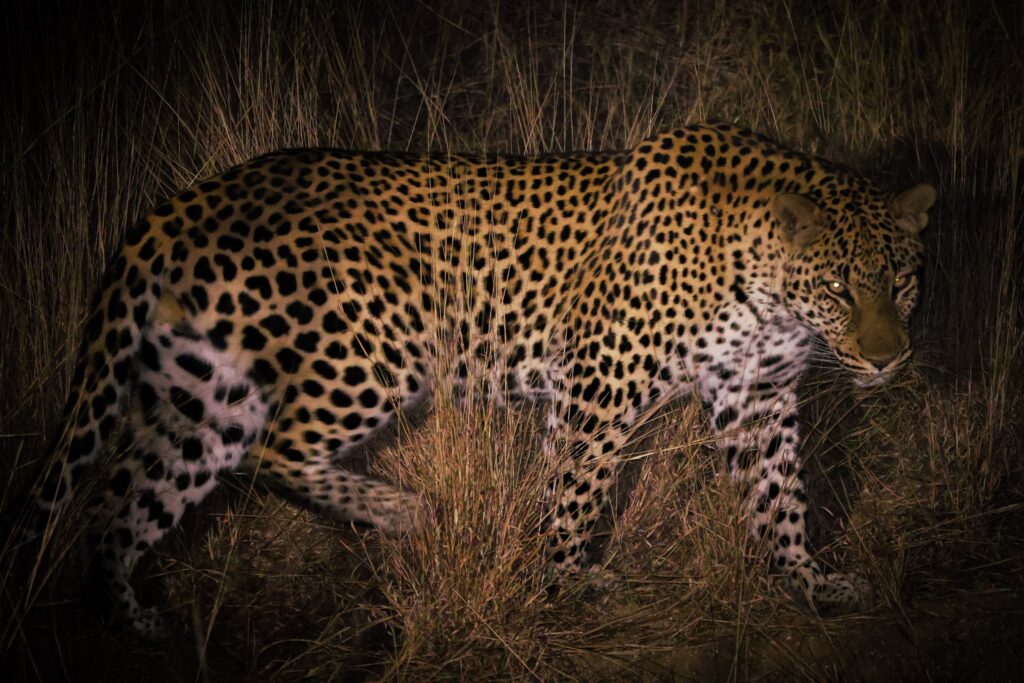
If you’re like me, the technical aspect of photography bores you, because let’s be honest, we got into photography to take cool photos, not to mess around with settings on a camera.
So I’ve done the hard work for you so all you need to do is set these up and enjoy your time photographing leopards.
Firstly, you want a shutter speed of 1/500th to 1/1000th of a second if the leopard is moving. This means you won’t have motion blur and can capture the leopard’s movements in focus.
For aperture, f/2.8 to f/4 is about right for night shots. This provides a good balance between background blur and sharpness, meaning the leopard is isolated from the background but still has a good depth of field.
Remember, I recommend taking some shots with a more narrow aperture so you can capture the environment and tell a story with your photos.
Last but not least, ISO, the one which everyone hates the most, or at least I do! As I’ve said throughout the post, you need to shoot with a higher ISO than normal as the leopards are most active at night, usually in pitch-black conditions.
It’s a big range but an ISO of 3200-12800 depending on your camera model should allow you to capture the leopard. And remember you can use flash too if you wish.
If you’re new to photography, I recommend learning the exposure triangle principles as this is what you will apply to get the right balance and capture the perfect shot. Because even though you can use these figures as guidance, they should only be used as guidance if you want the best shot possible.
How to Edit a Photo of a Leopard
Before I got into travelling and wildlife photography, I was a graphic designer, so naturally I really enjoy the editing side of photography.
In a world where everything is catered for social media, a lot of times you will see people say that editing can save a bad image and make it good, but I disagree.
I think editing can make a good image bad, but editing can make a good image GREAT. If you take a bad image, you can make it better, sure, but you can’t turn it into the shot of a lifetime.
As you will most likely be photographing leopards in poor light conditions, there are some general tips which can be applied to most photos. Of course, no two photos are the same and you should go through each setting individually to see what looks best, but generally speaking, this is what I do for my photos of leopards:
- Increase contrast: I photographed leopards during the Winter in South Africa, so colours were bland. Combine this with it being nighttime, and I needed to add contrast to help the leopard stand out from the background.
- Add a slight silhouette: Pretty much a non-negotiable for shots in low-light conditions if you ask me.
- Add sharpness: Would it really be wildlife photography without increasing the sharpness?
- Add a slight warm temperature: Again as it’s nighttime, the fake light (whether that be a spotlight or flash from your camera) will wash out the gorgeous yellow colour of the leopard’s fur, and this is a nice way to fix that.
- Darken the shadows: Once more, the artificial light will have a negative effect on your image. I would darken the shadows to help really show off the cheetah’s rosette pattern.
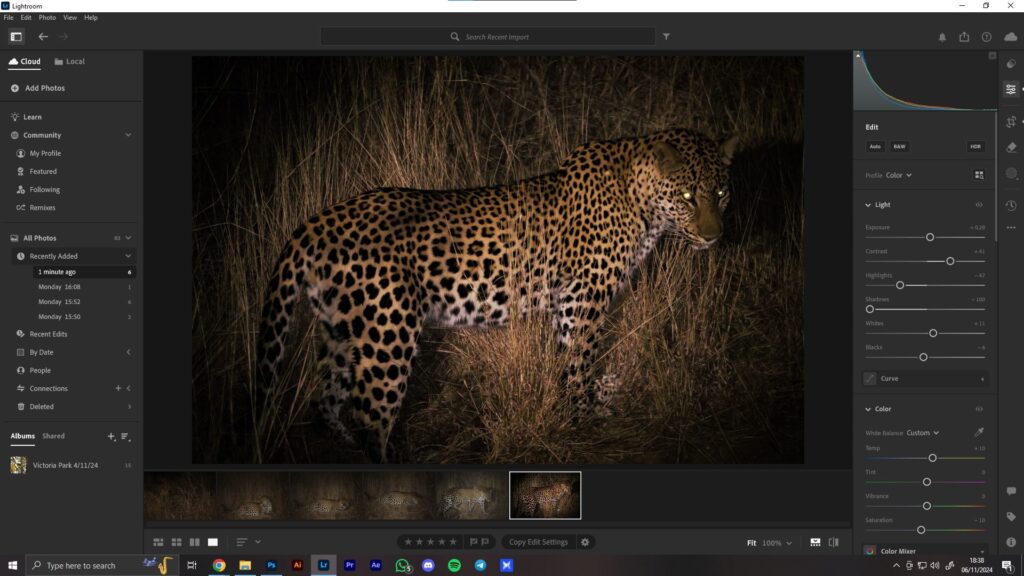
These are more or less the same settings I recommended in my lion photography guide if you are wondering how to edit photos of the King of the Jungle.
Photographing Leopard Ethics
If you are into wildlife photography, you probably love animals, right? It’s important to keep every animals welfare as your top priority.
Unfortunately, I see too many people willing to do anything to get the “perfect” shot. Whether it be climbing up a tree to photograph into a bird’s nest or literally chasing after animals if they run away from you.
This applies to leopards too, so here are a few important things you should consider when photographing leopards:
- Do not bait or lure: Feeding a leopard can disrupt their feeding and hunting patterns. They’re hard to find, but that doesn’t mean you can bait them. Plus if you let them hunt for themselves, you can also get some incredible snaps.
- Be quiet: Sounds obvious but it needs to be said. You should keep noise to a minimum when photographing any wildlife. Leopards have excellent hearing, so loud noises do disturb them such as banging if you drop something onto the jeep.
- Keep your distance: It’s possible to get close to leopards while still being ethical. For reference, the above shots are at 200mm. They rarely take notice of the jeeps, but that doesn’t mean you should push your luck and get too close for their comfort.
- Respect conservation attempts: In some parts of Africa, you might se a leopard wearing a colour as it is being tracked for conservation efforts. It’s easy to photoshop these out, and they help to ensure leopards will be around for generations to come.
- Don’t litter: I can’t believe I actually have to write this but the photo in my guide on how to photograph cheetahs shows that even in remote African savannahs you can find litter.
- Do not post exact locations of leopards: African Leopards are listed as vulnerable so it’s important to keep their locations safe and secure because believe it or not, people do poach leopards. Sad.
Conclusion
And there you have it, a complete guide on how to photograph leopards.
Leopards are my favourite of the Big 5 in Africa and I’m sure they’re near the top for you too. It’s truly a privilege to be able to photograph them.
To summarise the best way to do so, use a mirrorless camera that can handle a good ISO. With a telephoto lens, set your shutter speed fast to capture each movement, and a relatively high ISO since you will most likely be shooting at night.
But most importantly of all, have fun! Make memories as well as photos because leopards are amazing animals to simply watch, so remember to spend some time with your lens down, simply enjoying the experience with your own two eyes.
